Wednesday, 14 October 2015

Character Research

The are a few key aspects about my character:

  • She is female
  • She is 20 years old
  • She enjoys going out clubbing and drinking
  • She is very loud and confident (especially when drinking)
The story
My character is out on a fairly standard typical night out with her friends in a quite casual club. They are on the busy dance floor, drinks in hand, when another group of girls start bumping into them and barging them out of the way, My character begins to push back and it all starts to get quite heavy-handed, eventually a bouncer steps in and gives all of the girls a warning. The girls separate, and go they're own ways...

Later on in the night, out of no where, the other girl comes at my character with glass bottle, and tries to smash it round the back of her head. My character sees her out of the corner of her eye and tries to move out of the way. The girl manages to make enough contact to smash the bottle, and it hits my character at quite an awkward angle in her neck, leaving a glass shard piece sticking out of her neck. Blood begins running out of the wound and dripping down her neck. 

Her appearance
  • Wearing a fairly casual top, white jeans and high heels
  • Quite heavy 'modern' make-up, e.g. contouring & highlighting, false eyelashes, heavy eyeshadow (but in neutral colours), dark lipstick, etc.
  • Just before I take the pictures, I am going to drip some water down the face to show a couple of tears, but it is so soon after the event that the character is in shock and the pain has not actually hit her yet. Also, she will be wearing double-wear foundation, which is water resistant, so the make-up will not really move very much, unless she was substantially crying
  • Hair will have side parting and be straightened
  • Painted finger nails


Placement Of My Wound

I am going to have my glass shard wound placed on the side of the neck (as this is a realistic place to be bottled). 
The attacker does not manage to a massive amount of contact, so the glass does not penetrate very deeply into the neck. Therefore, it does not burst any nerves or veins, but as the glass is still in the neck, it is not possible to see the full extent of the damage...

The girl is young (around 19/20) and so does not have any loose skin or wrinkles on her neck. Therefore, the surface is quite flat and smooth. 


Technical Folder - Health And Safety

Always follow these steps when experimenting and using special effects makeup equipment:

  • Do not contaminate A or B, either together of with something else
  • Use different gloves when dealing with A and B to stop contamination.
  • Use different sticks to scoop out the product or to mix the products.
  • Don't use anything Aloe Vera based when using the products.
  • Always use an even amount of products A and B when mixing them together to get the right consistency.
  • Always make sure you mould is completely clean and dry before using because otherwise whatever is left in the mould will be in the next prosthetic piece.
  • Always spray the setting spray by an open window
  • Make sure your kit is always clean so that the products can last for as long as possible.
  • Always make sure all the products are stored correctly, i.e. in a cool place, with the bottles upright and with lids on.
  • Make sure you powder the latex well so that they don't stick together.
  • Wear clothes that you don't mind getting ruined because latex is almost impossible to get out.
  • Hair must be tied up
  • Don't wear any jewellery 


Creating The Sculpture For My Mould

  • First of all, I warmed up the clay using a cool hairdryer
  • I then placed a small amount of clay onto my surface
  • I rolled this out slightly and smoothed down the edges
  • I then got my glass shard (wrapped in a scarf, so that I did not cut myself), and stuck it into the middle of the clay
  • I applied quite a lot of pressure, to ensure that it had made a good indentation, and I also pressed the clay around the edges of the glass to make sure the glass was quite snug in the clay
  • I then removed the glass shard
  • I smoothed the edges out, cut them off (so the wound would not be too big) and then smoothed them down again
  • I did this a few times

The Background Story

My initial idea for my wound was that it would be on the side of the neck - and relatively small. It will be very soon after the incident has taken place, so there will be a lot of blood present, and there will not have been enough time for it to be infected (if it was going to have been). 


The story behind it was that a girl had been on a night out, and things had got a bit rowdy between her and another female. It began with a bit of pushing and shoving, but the girls were separated by the bouncer... Then, out of no where, the girl came and attacked the other girl and bottled her.
Luckily, the girl did not manage to make too much contact with the bottle, and thus did not penetrate the skin too deeply, but it did leave a small gushing wound, where it was visible to see a chunk of skin had been taken out. 

I then began to create a sculpture of this story...

Upon reflection, I wanted to make it a little bit more interesting, and for it to be distinctive that it was a glass shard wound, and not just annoy other wound. Therefore, I decided that I was going to have a piece of glass sticking out of the wound. This is where the bottle had been every brittle and got caught in the girls neck, and was left sticking out.

This meant that the way I created my sculpture would have to be changed... First of all, I considered using plastic, instead of glass, but I did not think it would look as authentic or realistic, and this is one of the key things that I am aiming for. I then researched fake glass shards (e.g. rubber):
But I did not have the time or money to do this. Therefore, I have decided to use a small piece of actual glass because (although this is the most dangerous) I can guarantee that this will give me the most authentic outcome. I smashed a clear pint glass, because this will allow me to clearly see any blood on it, and many alcoholic drinks are in clear bottles. 


Friday, 2 October 2015

Glass Shard Research


Glass shard: a broken piece or fragment of glass 


Injuries caused by glass, present a mixture of irregular slash/stab and blunt trauma wounds, where shards of glass produced on impact may puncture the skin, and larger sections of the glass cause slash-type wounds. 


Surface-Level Cuts: Possibly the least severe broken glass injury suffered are surface-level cuts. These injuries simply tear or cut the skin and do not penetrate deeper into the body’s tissue. Typically, surface-level cuts require minimal treatment, including cleaning and possible stitches to stop the bleeding.

Deep-Level Lacerations: When sharp pieces of glass penetrate deep inside the skin, deep-level lacerations can result. These types of injuries can include cuts and wounds that penetrate through the skin, the underlying skin tissue and muscle fibers, all the way through to the bone. Deep-level lacerations are very dangerous for a variety of reasons, including permanent disfigurement.

Severed Limbs: If a shard of broken glass is large enough or sharp enough to penetrate the body almost all the way through, a severed limb can result. If even one shard of glass penetrates the body at an especially vulnerable location, it could lead to a severed artery which requires the affected limb to be amputated.

Bleeding to Death: If a shard of broken glass hits the arteries in the neck or any other part of the body that is especially vulnerable, an injury victim can bleed to death in a matter of minutes if medical help does not arrive quickly.


This is someone who has been cut by glass around a swimming pool, which is why the blood is this colour, and why the body is wet.
This cut is on someone's foot
Quite a lot of glass shard wounds are on the hand, whereby people are holding a glass object and it smashes, or breaks, etc.

After this initial stage of research, I now need to decide whether I am going to create a surface-level cut or a deep-level laceration, and I need to figure out the placement of the wound. I need to ensure that the surface is flat so that the piece can be seamless attached to the skin, but also so that it is in a realistic, believable place.

At this moment in time, I am thinking of having my wound either on the neck or hand... I think these are realistic placements because I am going to have the model either be bottled, or a glass smash while they were holding it. I think both of these placements will be viable because they have fairly flat surfaces, and are believable.

Web refences:
http://www.fortheinjured.com/auto-broken-glass-injuries.html#top
http://www.forensicmed.co.uk/wounds/sharp-force-trauma/glass-wounds/
http://www.roamingjones.com/its-all-g/

Initial Using Of My Tools

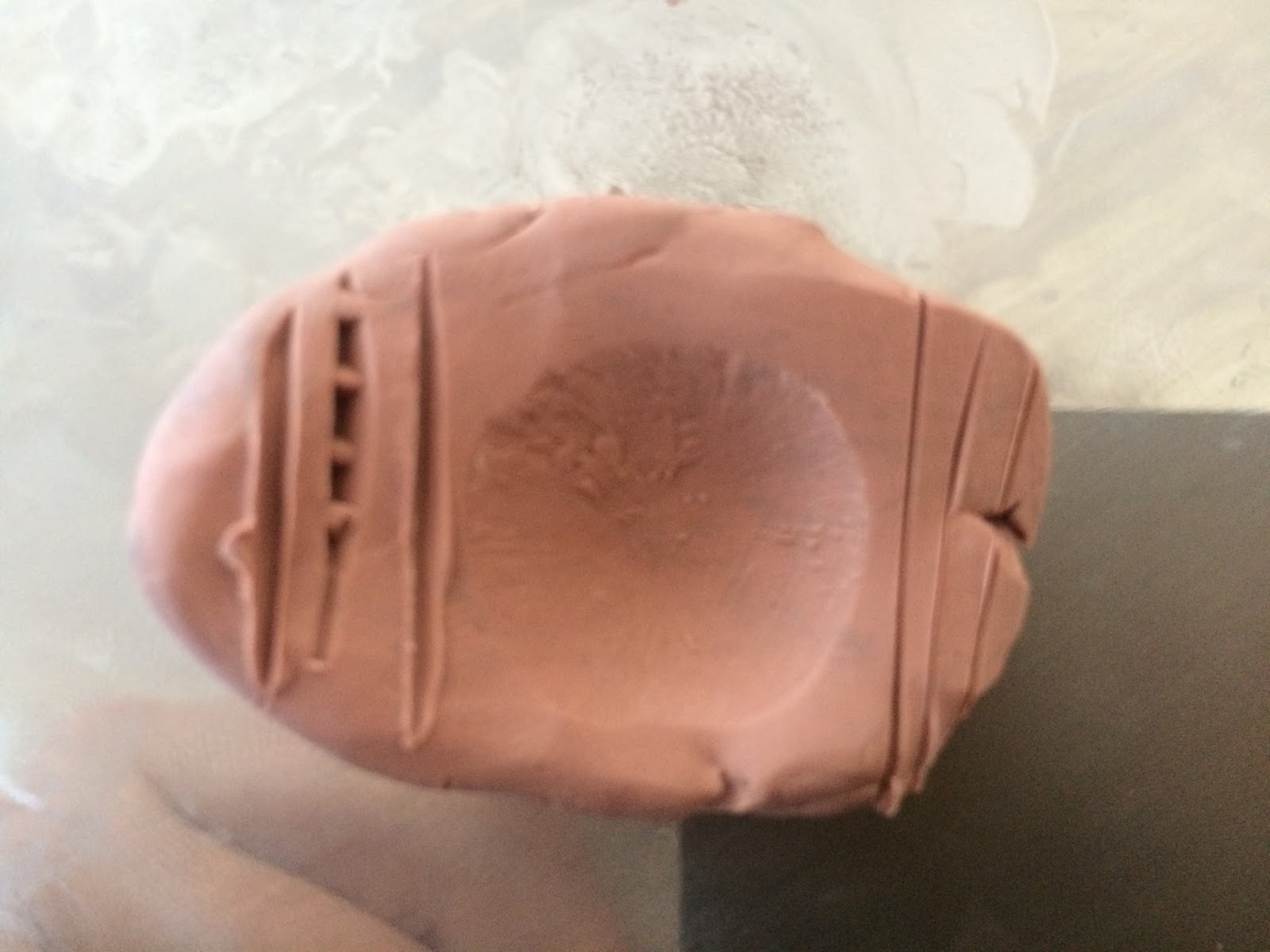
This is simply just a quick trial of using each of my tools, so that I can get a feel for what type of line/pattern each tool is able to create. 
These are all of my tools that were included in my kit - as you can see most of them are double-sided


As you can see, the tools cover a lotos ground - there are ways to produce indentations, very crisp, sharp lines, lines varying in width, etc. Some of the lines are actually quite similar, but there are slight differences between them, which will be crucial when working on very detailed pieces. 

At the moment, I am slightly confused as to what to use each of the tools for specifically, but I am very excited to learn how to use each of the tools and what wounds they are able to create.